CORRECTION: Sorry, I originally wrote the wrong address down above. I have made the correction, and will repeat here: www.beyondrecipes.blogspot.com
Showing posts with label Uganda. Show all posts
Showing posts with label Uganda. Show all posts
Friday, May 9, 2008
Ugandan Cuisine
While in Arusha I had a couple of friends stop by to visit. I took them out to the local joint we frequented while there: Hut made out of cardboard where you could get a solid meal of rice, beans and casava greens for about 50 cents. One of my friends, Tara, wrote up a review of it, complete with pictures, on her blog, www.beyondrecipes.blogspot.com. Check it out.
CORRECTION: Sorry, I originally wrote the wrong address down above. I have made the correction, and will repeat here: www.beyondrecipes.blogspot.com
CORRECTION: Sorry, I originally wrote the wrong address down above. I have made the correction, and will repeat here: www.beyondrecipes.blogspot.com
Thursday, April 10, 2008
From Zanzibar...
...but actually concerning Uganda, here are two anecdotes, one of which is (verifiably) true:
1) A year ago the Ugandan transportation minister was invited by his German counterpart to visit for an exchange of ideas. The German minister showed his guest his beautiful house, situated on the top of an expansive valley. The German minister took his friend out to his veranda and said,"Do you see that bridge in the distance?"
"Yes, yes I do!" The Ugandan exclaimed as he caught sight of a huge suspension bridge in the distance"
"80% there," The German minister said pointing to the bridge, "and 20% here" he said patting his pocket.
A few months later the Ugandan transportation minister invited the German minister to Uganda. The German was treated to a visit at the Ugandan minister's house, a spectacular mansion atop a hill outside of Kampala. From his patio the Ugandan minister pointed out below, asking the German, "Can you see that paved road there?"
The German, squinting hard, asked, "what road?"
"100% here" said the Ugandan with a smile, patting his pocket.
2) Two American health workers go to a Ugandan primary class to teach them about HIV/AIDS awareness. The two are accompanied by a town council member, one of the most respected men in the village. At the end of an hour-long session on safe and proper uses of a condom, the town council member addresses the class: "And so, boys and girls, we all know what sort of girls use condoms?" He hesitates for a moment as the class responds with silence. "That's right, working girls."
The story that isn't true was told to me today by a PhD student who had worked in Uganda for the past several months. I don't mean to be harsh on Uganda and its people, they really are great.
Having a rainy but good time in Zanzibar!
1) A year ago the Ugandan transportation minister was invited by his German counterpart to visit for an exchange of ideas. The German minister showed his guest his beautiful house, situated on the top of an expansive valley. The German minister took his friend out to his veranda and said,"Do you see that bridge in the distance?"
"Yes, yes I do!" The Ugandan exclaimed as he caught sight of a huge suspension bridge in the distance"
"80% there," The German minister said pointing to the bridge, "and 20% here" he said patting his pocket.
A few months later the Ugandan transportation minister invited the German minister to Uganda. The German was treated to a visit at the Ugandan minister's house, a spectacular mansion atop a hill outside of Kampala. From his patio the Ugandan minister pointed out below, asking the German, "Can you see that paved road there?"
The German, squinting hard, asked, "what road?"
"100% here" said the Ugandan with a smile, patting his pocket.
2) Two American health workers go to a Ugandan primary class to teach them about HIV/AIDS awareness. The two are accompanied by a town council member, one of the most respected men in the village. At the end of an hour-long session on safe and proper uses of a condom, the town council member addresses the class: "And so, boys and girls, we all know what sort of girls use condoms?" He hesitates for a moment as the class responds with silence. "That's right, working girls."
The story that isn't true was told to me today by a PhD student who had worked in Uganda for the past several months. I don't mean to be harsh on Uganda and its people, they really are great.
Having a rainy but good time in Zanzibar!
Monday, February 11, 2008
Both Kabila and Odinga With Blood On Their Hands
Last week I found myself in a conversation with one of the many local Safari hawkers here in Arusha (actually, it was a ploy to get him off the subject of selling me a safari trip). His contention was that Kabila was to be faulted for the violence in Kenya because it was he who rigged the December elections. I agreed with him, but urged him to consider that by not choosing non-violent tactics Odinga was guilty as well. Is it clear that Odinga has any direct link to the perpetrators of the ethnic violence between the two leaders' tribes? No, but the fact that he uses this violence to pressure Kabila means that he might as well be directly involved. Perhaps instead of pretending that such things are out of his control he should speak out forcefully against violence on both sides. Until he does that in a meaningful way he is just as bad as the man he is trying to replace.
On an entirely different topic, and as a fitting means of waving farewell to Uganda, the following is a conversation I had with an airline official at the baggage check-in at Entebbe Airport.
Official: "Your bags are eight kilograms too heavy. You will have to pay $40."
Me: "Dollars!?!?!"
Official: "...yes, dollars.'
Me: "That's outrageous, let me try to fit more into my carry-on bag."
Official: "ok, $20."
Me: "... (confused by the fact that this has become a negotiation)... um, no let me try..."
Official: "ok fine, you can go"
Me: "..."
On an entirely different topic, and as a fitting means of waving farewell to Uganda, the following is a conversation I had with an airline official at the baggage check-in at Entebbe Airport.
Official: "Your bags are eight kilograms too heavy. You will have to pay $40."
Me: "Dollars!?!?!"
Official: "...yes, dollars.'
Me: "That's outrageous, let me try to fit more into my carry-on bag."
Official: "ok, $20."
Me: "... (confused by the fact that this has become a negotiation)... um, no let me try..."
Official: "ok fine, you can go"
Me: "..."
Thursday, January 24, 2008
Globalized Football
This morning I listened to an excellent BBC radio piece on African footballers who try to get to Europe to play. The whole phenomena sounds chillingly like a juncture between colonization methods of a hundred years ago and modern issues of a globalizing economy. Also throw in this mix the notion that a lot of what goes on is actually human trafficking and it's really enough to utterly disgust you. I want my players to hear the segment, so I'm going to try and download the podcast.
Wednesday, January 23, 2008
Kawempe Boys
Before I forget, I should add that I've set up some of my players with their own blog, which I'm hoping they will be able to use as a learning tool and as a way of stayin in touch with me. Check it out, any support and signs up encouragement would go a long way in terms of keeping them interested:
kawempeboys.wordpress.com
kawempeboys.wordpress.com
Constructing Ugandan Modernity
Study #1: Mobile Phones
Uganda is a country where over half the population owns mobile phones. You can buy time by the second. It is customary for someone to call and then hang up, because it costs nothing to receive a call an they will expect you to call them back. Many people own phones and go weeks, even months without buying time. A man in the village my organization works in owns a phone but has never owned a SIM card, and therefore has never made a call. Says a lot about how social status transcends economic boundaries.
Study #2: Pop Culture
The homogeneousness of pop culture in Uganda is shocking, even for someone subject to the narrowness of contemporary American tastes. The variety of music on pop stations rivals mainstream clear channel stations in the US in terms of shortness of playlists. In terms of local music, the style vaguely mimics the repetitive and monotonous melodies of reggaetone with a bit of African gospel thrown in. Of course hip hop, usually Jamaican influenced, is prevalent. So much for the hipness of being different.
Clothing choices generally conform to whatever t-shirts and jumper sets have been shipped wholesale secondhand from the US. Any form of Arsenal or Man U jersey (see next section) are also a required component of any wardrobe.
Last month my organization hosted a youth talent show. The complete list of talents performed included: singing pop songs, "miming" (i.e. lipsyncing) pop songs, and dancing Usher-style to pop songs. A few also sang their own (poppy) songs and one boy, a player from my team, also juggled a soccer ball. Unfortunately, the show was performed by category, so that by the time the 20th poorly mimed song came on I was forced to excuse myself.
Study #3: Football
Perhaps more a sub-category of #2 (which itself could be put within another larger category, entitled "The Homogeneity of much of Ugandan Culture"), the viewing of professional football here is a stark example of the power an problems of globalized sport. As far as 90% of Ugandans are concerned, only two soccer teams, Arsenal and Man U are worth supporting. Another 5% root for Liverpool, though most can name at least a few of the other biggest clubs in Europe. However, the overwhelming dominance of the English Premier League attests to how the incredible reach Information and Communications Technology (ICT) has given us can simultaneously and seemingly paradoxically shrink the number of alternative choices presented to us.
Study #4: E-mail
The ultimate status symbol, people routinely ask for it even if they do not themselves own an email address or have access to a computer. I've had kids as young as six ask for mine. It is practically compulsory at the parting of a first meeting to exchange them. Yet the number or requests far exceeds the number of messages in my Inbox from these new friends. Email was the first thing that most of my students asked me to get for them. Of course, people who have rarely, if ever sat before a computer, let alone type a sentence or open a web browser, can hardly be expected to know even the basics of how to operate an email account. They think I'm beating around the bush when I demand that they at least learn correct typing methods before I show them how to sign up for email. Signing up for email addresses is like supporting soccer clubs here. Either you get your email from Yahoo or Google (although in reality the dominance of Yahoo in this respect mimics the dominance of the EPL much closer than the support for any given English club).
Study #5: Advertising
I love the Ugandan visual advertisements that are painted on building sides and storefronts. It seems better than littering surfaces with paper signs, not to mention cluttering up views with huge billboards (although there is a fair share of that as well). The names businesses choose are great as well, for a range of reasons. Shop Dot Com, a convenience store/gas station, uses its name to associate itself with the hip and modern Internet, although there isn't much beyond the name that the two share. The two local internet cafes I frequent use their names to connote superiority. Ultmate and Paramount, though not much about either could be called either. In many ways the names and advertisements of businesses here strive to put them on par with an imagined ideal that often doesn't fit with reality in any conceivable way. Perhaps its not so different from the US, but the change in perspective reveals more of the whimsical fantasy of advertising.
Uganda is a country where over half the population owns mobile phones. You can buy time by the second. It is customary for someone to call and then hang up, because it costs nothing to receive a call an they will expect you to call them back. Many people own phones and go weeks, even months without buying time. A man in the village my organization works in owns a phone but has never owned a SIM card, and therefore has never made a call. Says a lot about how social status transcends economic boundaries.
Study #2: Pop Culture
The homogeneousness of pop culture in Uganda is shocking, even for someone subject to the narrowness of contemporary American tastes. The variety of music on pop stations rivals mainstream clear channel stations in the US in terms of shortness of playlists. In terms of local music, the style vaguely mimics the repetitive and monotonous melodies of reggaetone with a bit of African gospel thrown in. Of course hip hop, usually Jamaican influenced, is prevalent. So much for the hipness of being different.
Clothing choices generally conform to whatever t-shirts and jumper sets have been shipped wholesale secondhand from the US. Any form of Arsenal or Man U jersey (see next section) are also a required component of any wardrobe.
Last month my organization hosted a youth talent show. The complete list of talents performed included: singing pop songs, "miming" (i.e. lipsyncing) pop songs, and dancing Usher-style to pop songs. A few also sang their own (poppy) songs and one boy, a player from my team, also juggled a soccer ball. Unfortunately, the show was performed by category, so that by the time the 20th poorly mimed song came on I was forced to excuse myself.
Study #3: Football
Perhaps more a sub-category of #2 (which itself could be put within another larger category, entitled "The Homogeneity of much of Ugandan Culture"), the viewing of professional football here is a stark example of the power an problems of globalized sport. As far as 90% of Ugandans are concerned, only two soccer teams, Arsenal and Man U are worth supporting. Another 5% root for Liverpool, though most can name at least a few of the other biggest clubs in Europe. However, the overwhelming dominance of the English Premier League attests to how the incredible reach Information and Communications Technology (ICT) has given us can simultaneously and seemingly paradoxically shrink the number of alternative choices presented to us.
Study #4: E-mail
The ultimate status symbol, people routinely ask for it even if they do not themselves own an email address or have access to a computer. I've had kids as young as six ask for mine. It is practically compulsory at the parting of a first meeting to exchange them. Yet the number or requests far exceeds the number of messages in my Inbox from these new friends. Email was the first thing that most of my students asked me to get for them. Of course, people who have rarely, if ever sat before a computer, let alone type a sentence or open a web browser, can hardly be expected to know even the basics of how to operate an email account. They think I'm beating around the bush when I demand that they at least learn correct typing methods before I show them how to sign up for email. Signing up for email addresses is like supporting soccer clubs here. Either you get your email from Yahoo or Google (although in reality the dominance of Yahoo in this respect mimics the dominance of the EPL much closer than the support for any given English club).
Study #5: Advertising
I love the Ugandan visual advertisements that are painted on building sides and storefronts. It seems better than littering surfaces with paper signs, not to mention cluttering up views with huge billboards (although there is a fair share of that as well). The names businesses choose are great as well, for a range of reasons. Shop Dot Com, a convenience store/gas station, uses its name to associate itself with the hip and modern Internet, although there isn't much beyond the name that the two share. The two local internet cafes I frequent use their names to connote superiority. Ultmate and Paramount, though not much about either could be called either. In many ways the names and advertisements of businesses here strive to put them on par with an imagined ideal that often doesn't fit with reality in any conceivable way. Perhaps its not so different from the US, but the change in perspective reveals more of the whimsical fantasy of advertising.
Saturday, January 12, 2008
Power and Corruption in Ugandan Football
The past couple of days I've spent more time than I probably should wondering what to term my latest African charity expense. I've decided that the best politically correct title would be "extra-legal expenses." A harsher but potentially more truthful name would be "bribe money." I've even toyed with putting down the simple generalization "African fee." Whatever you want to call it, I've recently become intimately familiar with the underhandedness that plagues many aspects of society here. In my case it's been my dealings with FUFA, or the Federation of Ugandan Football Associations.
In my humble, inexpert and short-lived experience in the eastern part of this continent I would have to agree with the commonly held opinion that Africa's greatest problem is that of corruption. Not that the West doesn't have its own forms of extortion, bribery and nepotism. The difference is in the details however, and in the form in which such things take place. Perhaps this is my problem: that I am too familiar and comfortable with the formalized routines by which my native society cheats its members. Perhaps it is because I am one of those who more often benefit from this institutionalized unfairness that I have less of a problem with it. Still, I can't help but find the more informal, in-your-face underhandedness in this part of the world annoying and troublesome.
Its not hard for me to imagine that many African countries are run somewhat like FUFA. The organization is populated by people that own or represent teams that fall under FUFA's jurisdiction, creating conflicts of interest that are impossible to ignore. It's hard to believe that the bureaucracy of the organization hasn’t been created for any reason aside from making money for a select few in positions of power. My induction into the legalities of the league confirmed this observation, as rule upon rule, real or imagined (I'm not sure as I have yet to receive a copy of the legal guidelines, despite several requests), has served no identifiable purpose other than creating more red tape, which a pay-off can often and conveniently resolve.
My dealings with FUFA officials have sharpened the unfortunate conclusion I have begun to make about the influence of people like me on African societies: I can only hope to leave this place no worse than I found it. As my time here carries on, I wonder more and more whether the impact I have on this society is or can ever be a positive one. The case and point of this is the example of bribery. In order to accomplish our goals here we inevitably run into situations where our complicity in bribery makes us accomplice to the engine that tears at the fabric of civil society. Refusing to participate in it results in the progress towards whatever your goal is grinding to a halt. Ok its a cynical, pessimistic conclusion, but I believe it actually helps me to prioritize my goals here. It's not meant to absolve myself from my ethical principles, but rather humble myself before a society devastated by colonialist theories of "improvement" and "progress." I shouldn't kid myself about altruistic motives; in the end, no matter how generous my actions are, I can't avoid the selfish reasons behind them. It's not a zero-sum game, we both can benefit, but missionary zeal is what I'd like to avoid.
In my humble, inexpert and short-lived experience in the eastern part of this continent I would have to agree with the commonly held opinion that Africa's greatest problem is that of corruption. Not that the West doesn't have its own forms of extortion, bribery and nepotism. The difference is in the details however, and in the form in which such things take place. Perhaps this is my problem: that I am too familiar and comfortable with the formalized routines by which my native society cheats its members. Perhaps it is because I am one of those who more often benefit from this institutionalized unfairness that I have less of a problem with it. Still, I can't help but find the more informal, in-your-face underhandedness in this part of the world annoying and troublesome.
Its not hard for me to imagine that many African countries are run somewhat like FUFA. The organization is populated by people that own or represent teams that fall under FUFA's jurisdiction, creating conflicts of interest that are impossible to ignore. It's hard to believe that the bureaucracy of the organization hasn’t been created for any reason aside from making money for a select few in positions of power. My induction into the legalities of the league confirmed this observation, as rule upon rule, real or imagined (I'm not sure as I have yet to receive a copy of the legal guidelines, despite several requests), has served no identifiable purpose other than creating more red tape, which a pay-off can often and conveniently resolve.
My dealings with FUFA officials have sharpened the unfortunate conclusion I have begun to make about the influence of people like me on African societies: I can only hope to leave this place no worse than I found it. As my time here carries on, I wonder more and more whether the impact I have on this society is or can ever be a positive one. The case and point of this is the example of bribery. In order to accomplish our goals here we inevitably run into situations where our complicity in bribery makes us accomplice to the engine that tears at the fabric of civil society. Refusing to participate in it results in the progress towards whatever your goal is grinding to a halt. Ok its a cynical, pessimistic conclusion, but I believe it actually helps me to prioritize my goals here. It's not meant to absolve myself from my ethical principles, but rather humble myself before a society devastated by colonialist theories of "improvement" and "progress." I shouldn't kid myself about altruistic motives; in the end, no matter how generous my actions are, I can't avoid the selfish reasons behind them. It's not a zero-sum game, we both can benefit, but missionary zeal is what I'd like to avoid.
Sunday, January 6, 2008
The Case of the Mystery Malaria
My general perspective on healthcare in Uganda this past week can be summed up in a few of the following inner-dialogue thoughts I've had recently (though I won't limit myself to just them):
"Is this treatment going to hurt more than the illness?"
"That's not what the last physician/nurse told me"
"I may be going crazy right now, but I'm pretty sure you are too"
Allow me to provide a chronology of medical trips this week:
Trip #1 (Kawempe clinic, Sunday): Feel terrible, get tested for malaria; told results are (extremely) positive, get anti-malarial drugs
Trip #2 (International Hospital Kampala, Wednesday): After feeling worse, get tested for malaria; find that I no longer have (never had??) malaria; told that medication I have been taking is either no longer effective against malaria or does not treat malaria at all; get proscribed new anti-malarials "just in case."
Trip #3 (The Surgery, Kampala, following Sunday): After some symptoms have persisted, seek another opinion; told that its not even worth getting tested again, since its obvious I was misdiagnosed before and don't have malaria (told, in fact, that no one has EVER gotten malaria in Africa while on Larium, which I am currently taking).
It's really hard to know what to believe anymore. Although this week has been a great study in the confusion that is healthcare in Uganda, it's been made less fun by the fact that I've been quite ill, and still am feeling symptoms. Do I have malaria? Did I ever? If not, then what do/did I have? No one can give me a strait answer that jives with my experiences, and because I'm a visitor I don't have a great sense about who or what to trust. It's been made easier by being with fellow foriegners, some of whom are also ill (although at times that also makes things a whole lot scarier), but it still doesn't help me feel comfortable with the decisions I have to make about my health. Add to this the sneaking suspicion that your weekly anti-malarials may actually be affecting your mental health, and you get one rather rough week.
No one freak out, I really am feeling much better.
"Is this treatment going to hurt more than the illness?"
"That's not what the last physician/nurse told me"
"I may be going crazy right now, but I'm pretty sure you are too"
Allow me to provide a chronology of medical trips this week:
Trip #1 (Kawempe clinic, Sunday): Feel terrible, get tested for malaria; told results are (extremely) positive, get anti-malarial drugs
Trip #2 (International Hospital Kampala, Wednesday): After feeling worse, get tested for malaria; find that I no longer have (never had??) malaria; told that medication I have been taking is either no longer effective against malaria or does not treat malaria at all; get proscribed new anti-malarials "just in case."
Trip #3 (The Surgery, Kampala, following Sunday): After some symptoms have persisted, seek another opinion; told that its not even worth getting tested again, since its obvious I was misdiagnosed before and don't have malaria (told, in fact, that no one has EVER gotten malaria in Africa while on Larium, which I am currently taking).
It's really hard to know what to believe anymore. Although this week has been a great study in the confusion that is healthcare in Uganda, it's been made less fun by the fact that I've been quite ill, and still am feeling symptoms. Do I have malaria? Did I ever? If not, then what do/did I have? No one can give me a strait answer that jives with my experiences, and because I'm a visitor I don't have a great sense about who or what to trust. It's been made easier by being with fellow foriegners, some of whom are also ill (although at times that also makes things a whole lot scarier), but it still doesn't help me feel comfortable with the decisions I have to make about my health. Add to this the sneaking suspicion that your weekly anti-malarials may actually be affecting your mental health, and you get one rather rough week.
No one freak out, I really am feeling much better.

Tuesday, January 1, 2008
Trouble in Kenya
Kampala's Daily Monitor has front page coverage of the violence going on in Kenya in the aftermath of the recent presidential elections there. Apparently local Kenyan media is reporting 124 deaths so far. Police have swarmed the country's city streets after the Kenyan election committee announced that incumbent Mwai Kibaki had won the election by some 200,000 votes. Opposition candidate Raila Odinga, along with a number of civil society organizations, has denounced the ballot count as rigged and claimed that at least 300,000 votes have been stolen from him. Kibaki was sworn into office hours after the results were announced, but Odinga has vowed to hold his own inauguration event in Nairobi on Thursday.
Violence has been reported to be the worse in the slums of Nairobi and in the western part of the country, where Odinga's supporters are based. In Mathare just outside of Nairobi police have been reported as announcing that they will shoot on sight and shoot to kill. Violence in western Kenya has forced people to flee into Uganda, where some have had to seek refuge out-doors under trees or with local churches.
The impact of the violence in Kenya on the Ugandan economy is already being felt, with gas prices rising and expected to rise even higher. About 78% of Uganda's exports and 90% of its imports go through Kenya, which means that continued violence could have a much deeper impact on the region. Already the Ugandan government and businesses are working to secure alternative trade lines through the Tanzanian-Ugandan border, both overland and by ship across Lake Victoria
All this has forced us to rethink our plans for traveling through Kenya to Tanzania at the end of the month. Tanzania by boat seems to me the most appealing, especially if violence in the DRC continues to strain the Ugandan-DRC border.
Violence has been reported to be the worse in the slums of Nairobi and in the western part of the country, where Odinga's supporters are based. In Mathare just outside of Nairobi police have been reported as announcing that they will shoot on sight and shoot to kill. Violence in western Kenya has forced people to flee into Uganda, where some have had to seek refuge out-doors under trees or with local churches.
The impact of the violence in Kenya on the Ugandan economy is already being felt, with gas prices rising and expected to rise even higher. About 78% of Uganda's exports and 90% of its imports go through Kenya, which means that continued violence could have a much deeper impact on the region. Already the Ugandan government and businesses are working to secure alternative trade lines through the Tanzanian-Ugandan border, both overland and by ship across Lake Victoria
All this has forced us to rethink our plans for traveling through Kenya to Tanzania at the end of the month. Tanzania by boat seems to me the most appealing, especially if violence in the DRC continues to strain the Ugandan-DRC border.
Monday, December 31, 2007
What I Got For Christmas
Apart from sunrise, sunset is my favorite time of day. So as I sit on the porch of the medical clinic, waiting the thirty minutes for my Malaria test results to come back, I enjoy streaks of the day's waning light against the passers by. The busy dirt street this evening is for me ubiquitously Ugandan, with its boda bodas zipping to and fro, men and women carrying their loads, and children everywhere playing.
Paraphrasing my computer dictionary, Malaria is defined as an intermittent and remittent fever caused by a protozoan parasite that invades the red blood cells. The parasite, transmitted by mosquitoes, is found in many tropical and subtropical regions throughout the world, including Uganda. The name Malaria originally comes from the 18th century Italian term "mala aria," which referred to the 'bad air' caused by fumes promulgating from marshlands. These fumes were originally thought to be the cause of the illness we now call Malaria.
As I sit watching people pass by I reflect on the consequences of my test results. Oddly, I'm split between which fate is better. The obvious downside of having Malaria is, of course, that you have malaria, and will always have it. On the other hand, I will also get drugs that should swiftly relieve my symptoms. If I don't have it I'll have to wait out my time in purgatory without a clear idea of what my ailment is or when my fever will end. On top of this is the added shame in coming to the clinic without the vindication of a serious illness; "No, it's not Malaria you Mzungu weakling." In any case, I had already managed to coach my football team throughout the entire weekend with the same sickness. Wouldn't Malaria have prohibited that?
While I wait two, toddlers approach me from next door. Even within the incredibly cute demographic of young Ugandan childrenin these two rank among the top decile. One of them, the older girl, is an institution on the block and regular instigator of the ever-popular "Mzungu, how are you" chant/singalong. Her bright eyes and excited smile are irresistible, and if it weren’t for the 20 plus year age difference between us (me being 24, she being around 4)I think I would have a serious crush on her. The other, I assume her slightly younger brother, shares her wide-eyed expression of continual awe and amusement. Together, Spik and Span converse with me, me reciting small words and phrases and them shouting incomprehensible commands at me in baby-talk Luganda. Behind me another adult patient laughs at our babelian discourse. Seemingly satisfied with talking, the younger brother begins to strip off his clothing, one article at a time (incidentally, he is only wearing a shirt and pants). First comes his shirt, which for a while stops to serve as a sort of turban as it makes its way over his head. When it finally does come off it transforms into a "terrible towel," swung around the head and against the ground for added emphasis. Incredibly amused but slightly embarrassed I chuckle to myself as I make continual side-long glances at the little sideshow act beside me. The older sister, not one to be left out as she observes both her younger brother and my reactions, raises her shirt to simultaneously reveal her full tummy and shield the bottom half of her face. Obviously inspired by my reaction, the boy proceeds to drop his shorts for his mixed audience of fellow toddlers, clinic patients and passersby on the street. I cannot contain myself, and my chuckle boils over into a full-on laugh, which reinforces the laughs of the fellow patients on the waitingroom-porch and the antics of the two kids. I laugh and laugh until I'm crying, the tears streaming down my face. And I welcomed the laughter of others around me. Together we enjoyed the ridiculous of everything.
My diagnosis, when it came, was both a relief and a sobering experience.
"Yes, you have Malaria."
"I do?"
"You even have Malaria plus."
"Malaria plus? What’s that?"
"You have Malaria plus more Malaria."
"Malaria plus more Malaria?"
"Yes. But, you will be ok because you will take this medicine."
Without a clear explanation of what this diagnosis signified, I eventually took it to mean that in fact I had been infected by more than one strain of Malaria. The treatment, apparently, is the following:
Metakelfin 500 mg, two tabs once after dinner the first night
Ciprofloxacin 500 mg, one tab twice a day 12 hours apart (morning and evening)
Various painkillers, multiple times a day
In addition I am continuing to take the weekly Larium dosage I got in the States.
I remember the first time the reality of the possibility of getting Malaria struck me. It was last spring while I was reading the blog of a Danish UN worker stationed in Uganda. Her account of getting the parasite, and especially her account of having dealing with reactions to having it hit home the reality of getting it. I think in part it was because I was reading her accounts at practically the same time that she was experiencing what she was writing about. Somehow the relationship between experience and account affected my interpretation of its consequences on me. It's not the first time blogging has had this impact on me, and in fact I think it is part of the reason why I find the medium so interesting. Real people wil real problems writing in nearly real-time.
Every time I get the feeling that Malaria isn’t so bad, Malaria seems to want to remind me of itself in yet another way. Yesterday it was my skin's hypersensitivity. Today it's stomach pains and diarrhea. Luckily, I have companions close by, some of whom have already experienced Malaria and even one who was diagnosed with it for the first time a day before me (Ian for those of you who'd like to know). I'm glad that I'm sick here, where Malaria is as much a part of life as chickenpox is back home. Still, I hope that this isn't the type of Christmas gift that keeps on giving.
Paraphrasing my computer dictionary, Malaria is defined as an intermittent and remittent fever caused by a protozoan parasite that invades the red blood cells. The parasite, transmitted by mosquitoes, is found in many tropical and subtropical regions throughout the world, including Uganda. The name Malaria originally comes from the 18th century Italian term "mala aria," which referred to the 'bad air' caused by fumes promulgating from marshlands. These fumes were originally thought to be the cause of the illness we now call Malaria.
As I sit watching people pass by I reflect on the consequences of my test results. Oddly, I'm split between which fate is better. The obvious downside of having Malaria is, of course, that you have malaria, and will always have it. On the other hand, I will also get drugs that should swiftly relieve my symptoms. If I don't have it I'll have to wait out my time in purgatory without a clear idea of what my ailment is or when my fever will end. On top of this is the added shame in coming to the clinic without the vindication of a serious illness; "No, it's not Malaria you Mzungu weakling." In any case, I had already managed to coach my football team throughout the entire weekend with the same sickness. Wouldn't Malaria have prohibited that?
While I wait two, toddlers approach me from next door. Even within the incredibly cute demographic of young Ugandan childrenin these two rank among the top decile. One of them, the older girl, is an institution on the block and regular instigator of the ever-popular "Mzungu, how are you" chant/singalong. Her bright eyes and excited smile are irresistible, and if it weren’t for the 20 plus year age difference between us (me being 24, she being around 4)I think I would have a serious crush on her. The other, I assume her slightly younger brother, shares her wide-eyed expression of continual awe and amusement. Together, Spik and Span converse with me, me reciting small words and phrases and them shouting incomprehensible commands at me in baby-talk Luganda. Behind me another adult patient laughs at our babelian discourse. Seemingly satisfied with talking, the younger brother begins to strip off his clothing, one article at a time (incidentally, he is only wearing a shirt and pants). First comes his shirt, which for a while stops to serve as a sort of turban as it makes its way over his head. When it finally does come off it transforms into a "terrible towel," swung around the head and against the ground for added emphasis. Incredibly amused but slightly embarrassed I chuckle to myself as I make continual side-long glances at the little sideshow act beside me. The older sister, not one to be left out as she observes both her younger brother and my reactions, raises her shirt to simultaneously reveal her full tummy and shield the bottom half of her face. Obviously inspired by my reaction, the boy proceeds to drop his shorts for his mixed audience of fellow toddlers, clinic patients and passersby on the street. I cannot contain myself, and my chuckle boils over into a full-on laugh, which reinforces the laughs of the fellow patients on the waitingroom-porch and the antics of the two kids. I laugh and laugh until I'm crying, the tears streaming down my face. And I welcomed the laughter of others around me. Together we enjoyed the ridiculous of everything.
My diagnosis, when it came, was both a relief and a sobering experience.
"Yes, you have Malaria."
"I do?"
"You even have Malaria plus."
"Malaria plus? What’s that?"
"You have Malaria plus more Malaria."
"Malaria plus more Malaria?"
"Yes. But, you will be ok because you will take this medicine."
Without a clear explanation of what this diagnosis signified, I eventually took it to mean that in fact I had been infected by more than one strain of Malaria. The treatment, apparently, is the following:
Metakelfin 500 mg, two tabs once after dinner the first night
Ciprofloxacin 500 mg, one tab twice a day 12 hours apart (morning and evening)
Various painkillers, multiple times a day
In addition I am continuing to take the weekly Larium dosage I got in the States.
I remember the first time the reality of the possibility of getting Malaria struck me. It was last spring while I was reading the blog of a Danish UN worker stationed in Uganda. Her account of getting the parasite, and especially her account of having dealing with reactions to having it hit home the reality of getting it. I think in part it was because I was reading her accounts at practically the same time that she was experiencing what she was writing about. Somehow the relationship between experience and account affected my interpretation of its consequences on me. It's not the first time blogging has had this impact on me, and in fact I think it is part of the reason why I find the medium so interesting. Real people wil real problems writing in nearly real-time.
Every time I get the feeling that Malaria isn’t so bad, Malaria seems to want to remind me of itself in yet another way. Yesterday it was my skin's hypersensitivity. Today it's stomach pains and diarrhea. Luckily, I have companions close by, some of whom have already experienced Malaria and even one who was diagnosed with it for the first time a day before me (Ian for those of you who'd like to know). I'm glad that I'm sick here, where Malaria is as much a part of life as chickenpox is back home. Still, I hope that this isn't the type of Christmas gift that keeps on giving.
Tuesday, December 25, 2007
Christmas and Conservation
Today actually seems quite festive here, with Christmas music and decorations abounding. Unfortunately, my mood at the internet cafe isn't as festive due to the poor connection speed.
Several factors, including the nature of consumerism and consumption here, the book I'm reading (Thoreaux's Walden) and news about local and national environmental events back home, have got me thinking about what it means to live an environmentally aware lifestyle. On the one hand some things, like energy consumption, are easy to mitigate here, where both infrastructure and money are lacking. On the other hand some things, like physical waste and sewage, are a nightmare. It's fascinating how social perception and the status quo can be so different between communities. Here, using a fraction of the power and water we use in the States goes hand in hand with littering any time, anywhere. Both take place on levels unthinkable in the U.S. How can it be so difficult to have Americans change thier lightbulbs (and save money in the process!), while flourescents are nearly universal here? Why is the recent decision to place 500 garbage bins (probably the first ever) on Kampala street corners need be such a newsworthy achievement? Public attitude has a lot to do with it, and its one of the reasons why we should pay more attention to changing public perception about conservation in the U.S. (which, I will add, isn't to say we need to shove environmentalism down everyone's throat. There are enough reasons to conserve besides the environmental benefit. Let's think pragmatically).
I'm not entirely sure why I felt this was a good Christmas topic, but given the stark difference between the American Xmas consumer-fest (of which I normally and happily take part in) and the Ugandan version, I thought the reflection appropriate.
Merry Christmas!
Several factors, including the nature of consumerism and consumption here, the book I'm reading (Thoreaux's Walden) and news about local and national environmental events back home, have got me thinking about what it means to live an environmentally aware lifestyle. On the one hand some things, like energy consumption, are easy to mitigate here, where both infrastructure and money are lacking. On the other hand some things, like physical waste and sewage, are a nightmare. It's fascinating how social perception and the status quo can be so different between communities. Here, using a fraction of the power and water we use in the States goes hand in hand with littering any time, anywhere. Both take place on levels unthinkable in the U.S. How can it be so difficult to have Americans change thier lightbulbs (and save money in the process!), while flourescents are nearly universal here? Why is the recent decision to place 500 garbage bins (probably the first ever) on Kampala street corners need be such a newsworthy achievement? Public attitude has a lot to do with it, and its one of the reasons why we should pay more attention to changing public perception about conservation in the U.S. (which, I will add, isn't to say we need to shove environmentalism down everyone's throat. There are enough reasons to conserve besides the environmental benefit. Let's think pragmatically).
I'm not entirely sure why I felt this was a good Christmas topic, but given the stark difference between the American Xmas consumer-fest (of which I normally and happily take part in) and the Ugandan version, I thought the reflection appropriate.
Merry Christmas!
Wednesday, December 19, 2007
Witchcraft
Over the last few weeks I've become introduced, through clips and snippets of conversations, to the topic of witchfract in Uganda and Africa. I've yet to watch the video Big gave me on the subject, but he swears by all that is good that it will convince me of their powers. For instance, apparently there is a way to tunnel underground or under water to attain great material wealth and riches. This explains how some Africans become rich without seeming to earn money working.
Today Big's stories of witchcraft were corroborated by Steve and Frank, two other players on the football team I coach. They say that the power witch doctors wield in African is large, and that there are many witch doctors in Uganda and even in Kawempe, where I stay. They say that some of these witch doctores are pastors by day, although from my talk with them it seemed liek for the most part witch doctors are scorned by church-goers. Interestingly, many Christians in Uganda believe that these traditional withc doctors do the work of Satan, which seems to have the effect of legitimizing their power and authority within the community. Steve said that he spoke with his pastor about witch doctors, and was told that they worked for the devil, who had more influence on earth than God.
Steve and Frank have also informed me that rumor has it Didier Drogba, Chelsea's star Cote d'Ivoire striker, gained his power from witchcraft. This is meant to explain his rise to fame, as well as his teammate's, Ukranian striker Andreav Schevchenko, lack-luster performance at Chelsea after he was traded from A.C. Milan. Ditto goes for the Argentinian Hernan Crespo. When I asked why the Drogba-initiated curse haven't affected Chelsea midfielder Michael Essian (from Ghana), Steve reported that it was much more difficult to cure and African.
In general I've found superstition in Uganda a very real, if suble, part of everyday life, ranging from neighbors hexing "possessed" dogs to curses in children's games.
Today Big's stories of witchcraft were corroborated by Steve and Frank, two other players on the football team I coach. They say that the power witch doctors wield in African is large, and that there are many witch doctors in Uganda and even in Kawempe, where I stay. They say that some of these witch doctores are pastors by day, although from my talk with them it seemed liek for the most part witch doctors are scorned by church-goers. Interestingly, many Christians in Uganda believe that these traditional withc doctors do the work of Satan, which seems to have the effect of legitimizing their power and authority within the community. Steve said that he spoke with his pastor about witch doctors, and was told that they worked for the devil, who had more influence on earth than God.
Steve and Frank have also informed me that rumor has it Didier Drogba, Chelsea's star Cote d'Ivoire striker, gained his power from witchcraft. This is meant to explain his rise to fame, as well as his teammate's, Ukranian striker Andreav Schevchenko, lack-luster performance at Chelsea after he was traded from A.C. Milan. Ditto goes for the Argentinian Hernan Crespo. When I asked why the Drogba-initiated curse haven't affected Chelsea midfielder Michael Essian (from Ghana), Steve reported that it was much more difficult to cure and African.
In general I've found superstition in Uganda a very real, if suble, part of everyday life, ranging from neighbors hexing "possessed" dogs to curses in children's games.
Tuesday, December 4, 2007
Ugandan Top Ten
My top ten favorites so far in Uganda:
#10) Hanging out on my front porch listening to the BBC.
#9) Watching the Kawempe street traffic from the third floor internet cafe terrace.
#8) Playing Scrabble with the boys on my soccer team.
#7) Watching the fire flies on the path to my house at dusk.
#6) Rolexes/Kikommandos.
#5) Sunday brunch at 1,000 Cup coffee shop in Kampala.
#4) Sipping a Nile Special with the locals at Twins' Bar.
#3) Riding the ferry from Kalangala to Entebbe on lake Victoria.
#2) Eating the "local food" dish (beans/peas, rice, corn posho, banana, casava and sweet potato).
#1) Surprising happy Ugandans with my basic Luganda language knowledge.
#10) Hanging out on my front porch listening to the BBC.
#9) Watching the Kawempe street traffic from the third floor internet cafe terrace.
#8) Playing Scrabble with the boys on my soccer team.
#7) Watching the fire flies on the path to my house at dusk.
#6) Rolexes/Kikommandos.
#5) Sunday brunch at 1,000 Cup coffee shop in Kampala.
#4) Sipping a Nile Special with the locals at Twins' Bar.
#3) Riding the ferry from Kalangala to Entebbe on lake Victoria.
#2) Eating the "local food" dish (beans/peas, rice, corn posho, banana, casava and sweet potato).
#1) Surprising happy Ugandans with my basic Luganda language knowledge.
Sunday, December 2, 2007
TASAAAGA Update
NOTE: This should be up on my website but because I'm having problems accessing it right now I thought I'd put it here and link to it later.
The team that has been called the TASAAGA Football Club informally for the past two months since its formation now has an official name: Christian Alexander Football Club. I wasn't initially happy with the choice, but I've since been convinced that it was the players' decision and one of the only ways in which they could repay me for the work and resources I've put in to make the club a reality. Of course I've tried to make them realize that it wasn't just me who made this happen, but also everyone who has helped me get here and do this work. In the end however I had to accept the name. We have registered for our first tournament, the Ogonto Co-operative Tournament, and will be competing with 15 other teams for the top prizes: a bull for first place and a goat for second. Our first game was a draw after an unfortunate late minute equalizer by the opposing team. Unhappily, I was away at Lake Victoria and missed the first match, but am excited to see us again in action next week. We are also working to get the team registered with the national Ugandan league in the 2nd division.
Classes for the kids have also begun, and I'm excited about their current enthusiasm and alittle nervous about meeting their expectations. The real trick is to keep the topics interesting enough to get them to come back, analytical enough to satisfy my own standards, and practical enough to be of some use to them. So far I think I've done a good enough job, but I'm going to have to continue to put work in if I hope to accomplish everything I'd like to.
I've definitely felt a tinge of homesickness during the past week or two. I expect this is natural, and so instead of suppressing it I've simply worked to keep the daydreaming positive and avoid it from clouding my experience here.
It was great to see Jay, a college buddy, drop in from Jo-berg for the weekend. I'm looking forward to seeing Ian when he comes up here soon.
The team that has been called the TASAAGA Football Club informally for the past two months since its formation now has an official name: Christian Alexander Football Club. I wasn't initially happy with the choice, but I've since been convinced that it was the players' decision and one of the only ways in which they could repay me for the work and resources I've put in to make the club a reality. Of course I've tried to make them realize that it wasn't just me who made this happen, but also everyone who has helped me get here and do this work. In the end however I had to accept the name. We have registered for our first tournament, the Ogonto Co-operative Tournament, and will be competing with 15 other teams for the top prizes: a bull for first place and a goat for second. Our first game was a draw after an unfortunate late minute equalizer by the opposing team. Unhappily, I was away at Lake Victoria and missed the first match, but am excited to see us again in action next week. We are also working to get the team registered with the national Ugandan league in the 2nd division.
Classes for the kids have also begun, and I'm excited about their current enthusiasm and alittle nervous about meeting their expectations. The real trick is to keep the topics interesting enough to get them to come back, analytical enough to satisfy my own standards, and practical enough to be of some use to them. So far I think I've done a good enough job, but I'm going to have to continue to put work in if I hope to accomplish everything I'd like to.
I've definitely felt a tinge of homesickness during the past week or two. I expect this is natural, and so instead of suppressing it I've simply worked to keep the daydreaming positive and avoid it from clouding my experience here.
It was great to see Jay, a college buddy, drop in from Jo-berg for the weekend. I'm looking forward to seeing Ian when he comes up here soon.
Sun Power on Lake Victoria
Of all the curious comparisons one could make between Uganda and the US, I think that it is those things here that most imitate what I wish were true at home that I find the most interesting. An example demonstrates how Africa influences my ideas about my utopian America.
This week I graveled to the Sesse Islands, located on Lake Victoria. The islands are located fairly near to Entebbe, and hold some of the most beautiful sceneries I've yet found in Uganda. The islands are responsible for their own electricity, and as such have found solar power to be one of the most cost effective ways of making this happen. Throughout the villages and local hotels in the Kalangala district, where I was staying, one could find solar panels on rooftops and makeshift stands quite easily. A local store in town catered to the solar market, and the town even had an internet cafe that used solar power.
Unfortunately, I didn't get the chance to speak with either the solar store owner or his clients about the details of the industry there. Still, it blows my mind that one of the most powerful sources of energy we have is being put to better use here than in most places back home. Of course they also use less energy here in general, something we would also do well to imitate. Like most Americans, I wouldn't choose to live using as little power as Ugandans do, but living here does definitely help put into perspective what aspects of our lifestyle are complete wastes of energy.
My interest with cost effective renewable energy may lead me back down there again to do a little more research. I imagine that we may have something to learn from them, for in a land where wealth and resources are severely limited a necessity is put on being efficient.
Pictures should be here, but I'm having trouble uploading them right now. They should be up later.
This week I graveled to the Sesse Islands, located on Lake Victoria. The islands are located fairly near to Entebbe, and hold some of the most beautiful sceneries I've yet found in Uganda. The islands are responsible for their own electricity, and as such have found solar power to be one of the most cost effective ways of making this happen. Throughout the villages and local hotels in the Kalangala district, where I was staying, one could find solar panels on rooftops and makeshift stands quite easily. A local store in town catered to the solar market, and the town even had an internet cafe that used solar power.
Unfortunately, I didn't get the chance to speak with either the solar store owner or his clients about the details of the industry there. Still, it blows my mind that one of the most powerful sources of energy we have is being put to better use here than in most places back home. Of course they also use less energy here in general, something we would also do well to imitate. Like most Americans, I wouldn't choose to live using as little power as Ugandans do, but living here does definitely help put into perspective what aspects of our lifestyle are complete wastes of energy.
My interest with cost effective renewable energy may lead me back down there again to do a little more research. I imagine that we may have something to learn from them, for in a land where wealth and resources are severely limited a necessity is put on being efficient.
Pictures should be here, but I'm having trouble uploading them right now. They should be up later.
Tuesday, November 27, 2007
Slowly, Slowly
The places: Home, the office, the youth center, the soccer pitch. Kawempe stage, “downtown,” Sitebale, the hilltop.
The people: Bruhan, Big, Violet, Moses, Rashida, Kayanja John, Patience, Roy, Stevie, Franka, Max. Of course there’s also Sarah, the “kazungu.”

Slowly the list of names and places grow as the number of days here lengthen. First a small number of names for a large number of faces. “Slowly, slowly,” as my assistant coach Kayanja John says, I learn to familiarize the faces and identify the places. Slowly, slowly, I put together the rhythm of my life here. Nothing is on time, especially me. Yes, there is an internet café a ten minute’s walk from my house. No, most of the time I’m not able to do much besides check my mail before the power goes out (or even if it doesn’t, before I’ve spent two hours watching my time run down and the page fail to load yet again). Yes, I feel exhausted at the end of each day. No, actually I can’t exactly say that I accomplished much in that day. Maybe I did do something, in between all the walking and waiting and explaining and trying to understand. I’m sure of it, actually, but what exactly is sometimes hard to say.
To the Sesse Islands this week. Lake Victoria is amazing; this weekend while I was there all I could do was day dream about owning a small home on its shores. I wonder what the real estate laws are here.
The people: Bruhan, Big, Violet, Moses, Rashida, Kayanja John, Patience, Roy, Stevie, Franka, Max. Of course there’s also Sarah, the “kazungu.”
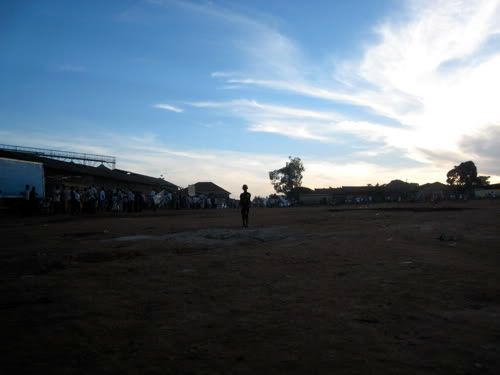
Slowly the list of names and places grow as the number of days here lengthen. First a small number of names for a large number of faces. “Slowly, slowly,” as my assistant coach Kayanja John says, I learn to familiarize the faces and identify the places. Slowly, slowly, I put together the rhythm of my life here. Nothing is on time, especially me. Yes, there is an internet café a ten minute’s walk from my house. No, most of the time I’m not able to do much besides check my mail before the power goes out (or even if it doesn’t, before I’ve spent two hours watching my time run down and the page fail to load yet again). Yes, I feel exhausted at the end of each day. No, actually I can’t exactly say that I accomplished much in that day. Maybe I did do something, in between all the walking and waiting and explaining and trying to understand. I’m sure of it, actually, but what exactly is sometimes hard to say.
To the Sesse Islands this week. Lake Victoria is amazing; this weekend while I was there all I could do was day dream about owning a small home on its shores. I wonder what the real estate laws are here.
Thursday, November 22, 2007
Many Things At Once, The News Hardly At All
Out of the maze of topics I could write about I'm choosing a few quick ones based mostly on whim.
David Weinberger's recent article on Facebook advertisement defaults. It's an insidious plan to be sure, but what would you expect from a profit-driven business? Also, Facebook on the users' side? I guess so, although not by default but rather by necessity. If it hadn't been for a major outcry from users a few years back the Facebook wall would have still told all.
Howard French's New York Times letter from China was interesting in its attempt to discuss what modernity means to the Chinese. It's actually funny how China is attempting a cookie-cutter approach to traditional Western modernization, complete with a World's Fair (so turn of the last century, no?) and an Olympics.
Protests in Tehran, and a rebuke of Ahmadinejad by a prominent conservative Iranian newspaper trickled down to me, but I've yet to read up on them.
News here comes mainly in the form of the BBC Radio station I listen to at home. Internet is slow and unpredictable, and international papers are available only in Kampala (at a little oasis of bourgeois luxury called "Thousand Cups Coffee House"). Life here is sinking into some form of regularity, which is welcome after a month and a half of seeming un-ending transition. A college friend will visit this weekend, and another may come next month, which will be sure to spice up my life a little.
David Weinberger's recent article on Facebook advertisement defaults. It's an insidious plan to be sure, but what would you expect from a profit-driven business? Also, Facebook on the users' side? I guess so, although not by default but rather by necessity. If it hadn't been for a major outcry from users a few years back the Facebook wall would have still told all.
Howard French's New York Times letter from China was interesting in its attempt to discuss what modernity means to the Chinese. It's actually funny how China is attempting a cookie-cutter approach to traditional Western modernization, complete with a World's Fair (so turn of the last century, no?) and an Olympics.
Protests in Tehran, and a rebuke of Ahmadinejad by a prominent conservative Iranian newspaper trickled down to me, but I've yet to read up on them.
News here comes mainly in the form of the BBC Radio station I listen to at home. Internet is slow and unpredictable, and international papers are available only in Kampala (at a little oasis of bourgeois luxury called "Thousand Cups Coffee House"). Life here is sinking into some form of regularity, which is welcome after a month and a half of seeming un-ending transition. A college friend will visit this weekend, and another may come next month, which will be sure to spice up my life a little.
Saturday, November 17, 2007
Teaching and Learning
As of last week I live in Kawempe, Uganda. I work as a soccer coach and youth coordinator. That means lots of things. I teach kids soccer. I teach kids English. I teach my assistant coach English. I try to learn Luganda: Oliyotya Sebo! Nzay Christian. Ellinyalyo qwani? Webale nyo! Welaba!
There's no set learning time, and there is no designated teaching time. Most often someone will tell me when I should start teaching or learning. Many times I'm learning just by being here. Some of the most important things I've learned I had never thought about learning before: How to live without electricity (some of the time) or running water (all of the time). How to find my home. How to communicate non-verbally. How to speak English with a Ugandan accent (I want wha-tuh). How to stay (relatively) clean.
I'm even relearning old things, like soccer. More specifically, I'm learning to coach. I'm learning tactics, practice drills. I'm learning how to manage a bunch of teenagers with a whistle. Being a mzungu (white man) helps, because they are already interested in everything I do, every gesture, every word.
Of course most of what I do is bluff. Bluffing is necessary when experience is lacking. Do I know what I'm doing half the time? (No.) Does it matter, as long as people have confidence in me? (Again, no.) I teach and I coach as best I can, without much experience at either. So far it seems to be working. Gradually, I plan to replace some of that bluffing with experience, both as a teacher- of soccer/English/life- and as a student- of Uganda/Luganda/life.
I think this is how life works. Please, correct me if I'm wrong.
There's no set learning time, and there is no designated teaching time. Most often someone will tell me when I should start teaching or learning. Many times I'm learning just by being here. Some of the most important things I've learned I had never thought about learning before: How to live without electricity (some of the time) or running water (all of the time). How to find my home. How to communicate non-verbally. How to speak English with a Ugandan accent (I want wha-tuh). How to stay (relatively) clean.
I'm even relearning old things, like soccer. More specifically, I'm learning to coach. I'm learning tactics, practice drills. I'm learning how to manage a bunch of teenagers with a whistle. Being a mzungu (white man) helps, because they are already interested in everything I do, every gesture, every word.
Of course most of what I do is bluff. Bluffing is necessary when experience is lacking. Do I know what I'm doing half the time? (No.) Does it matter, as long as people have confidence in me? (Again, no.) I teach and I coach as best I can, without much experience at either. So far it seems to be working. Gradually, I plan to replace some of that bluffing with experience, both as a teacher- of soccer/English/life- and as a student- of Uganda/Luganda/life.
I think this is how life works. Please, correct me if I'm wrong.
Saturday, November 10, 2007
Finally
I'll start by saying that the 50 or so hours in transit from Ari's in Chennai to Kampala Uganda were some of the most harrowing of the trip. For instance, accidentally throwing away my passport in Ari's garbage and not realizing it until I had arrived at the airport to depart was a classic "Bohn" moment. Luckily, thanks to the regularity of flight delays in that country, my hour-long taxi ride to Ari's and back did not make me miss my flight. No thanks, however, to the Indian taxi driver who did everything in his capacity to extend my stay in Chennai (and then ask for a tip). Little did I know that I would be spending that night in the Mumbai airport (arriving at midnight, taking off at nine), rated one of the worst airports to sleep in by sleepinginairports.com (earlier Bankok entry now posted there). Let me say that I completely agree with this evaluation: Never, NEVER stay overnight in the Mumbai airport if you can help it.
Oddly, thankfully, it was a (literal) breath of fresh air landing in Nairobi. "Nairobbery" has a terrible reputation, but we found it temperate, sunny, and relaxed compared to the craziness of India. The 12 hour bus ride to Kampala however clearly demonstrated the lack of infrastructure (exampled here in the "off-road" roads) in Africa, even when compared to India. I spent the first 20 minutes of this ride thinking of apt anologies (examples: world's worst roller-coaster ride, a U.S. "shock and awe" military campaign, riding the end of a buzz saw, driving up my Santa Fe washboard driveway one million times in a row), and the other 11 1/2 hours hating myself for not flying.
We are now safely in Kawempe, a suburb of Kampala, working for an organization called TASAAGA (more on this later). Apologies for the brevity and vagueness of this post.
Oddly, thankfully, it was a (literal) breath of fresh air landing in Nairobi. "Nairobbery" has a terrible reputation, but we found it temperate, sunny, and relaxed compared to the craziness of India. The 12 hour bus ride to Kampala however clearly demonstrated the lack of infrastructure (exampled here in the "off-road" roads) in Africa, even when compared to India. I spent the first 20 minutes of this ride thinking of apt anologies (examples: world's worst roller-coaster ride, a U.S. "shock and awe" military campaign, riding the end of a buzz saw, driving up my Santa Fe washboard driveway one million times in a row), and the other 11 1/2 hours hating myself for not flying.
We are now safely in Kawempe, a suburb of Kampala, working for an organization called TASAAGA (more on this later). Apologies for the brevity and vagueness of this post.
Monday, July 9, 2007
Lately I've been delving into more academic texts about the status of Information and Communications Technology (ICT) in Africa. Most of the stuff I've read so far has been at least a couple of years old, but it's still been very informative and somewhat inspiring. Take this for instance. It talks about setting up a low cost non-profit ISP in rural Uganda. Sounds like a great project, if a little too over my head to think about doing myself. Nonetheless, I admire their drive. I am also trying to get my hands on the entire issue of Telematics and Informatics from February 2004, which is all about ICT in Africa. I found one of the included articles about a blogger survey in Kamapala which I might try to build on when I'm over there.
Finally, I also found some newer stuff going on. I've never heard of the One Laptop Per Child Foundation before, but if their idea for a low-cost, low-impact computer is viable, then it sounds pretty cool!
An update about the project
Finally, I also found some newer stuff going on. I've never heard of the One Laptop Per Child Foundation before, but if their idea for a low-cost, low-impact computer is viable, then it sounds pretty cool!
An update about the project
Subscribe to:
Posts (Atom)